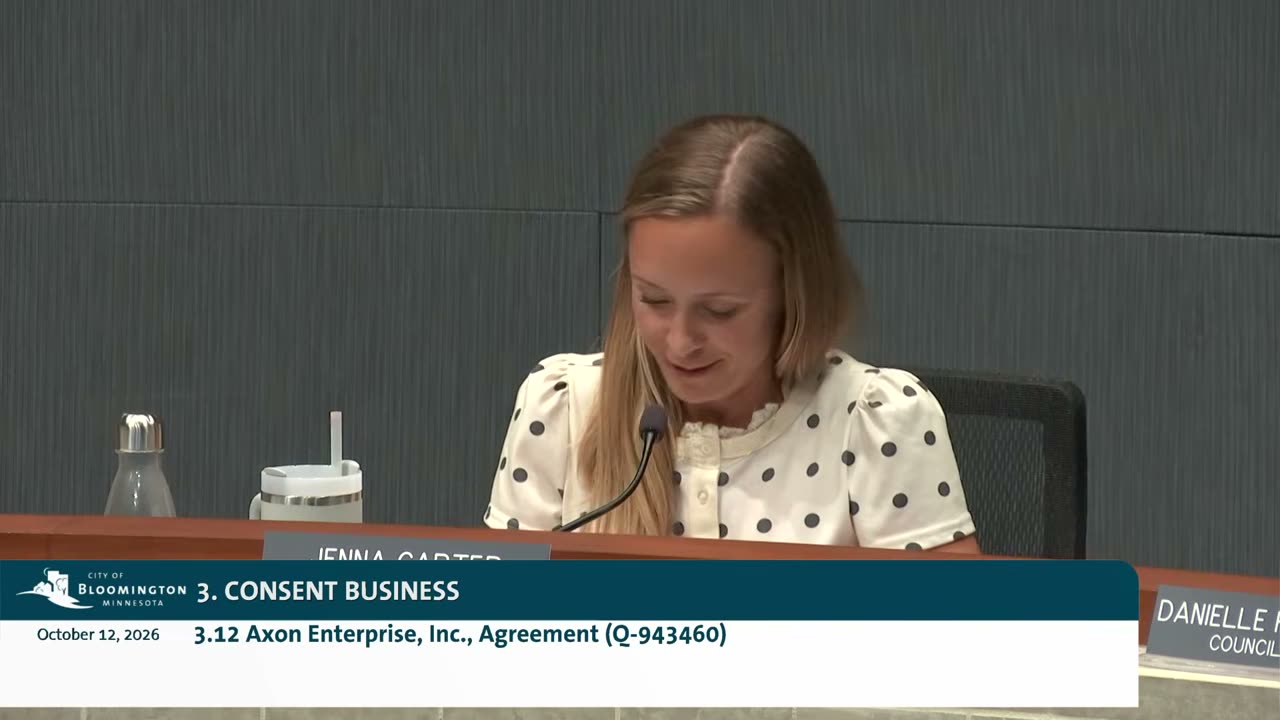
The council voted 7-0 to approve an expanded agreement with Axon Enterprise, piggybacking on a State of Minnesota/NASPO cooperative procurement contract, after the item was pulled from consent for public discussion. Police Chief Booker Hodges said the expansion adds drones as first responders plus translation and dispatch tools, insisted it is not spyware, noted Bloomington declined to adopt Flock cameras over data-sharing concerns, and said the drones would have helped catch the shooters in a recent incident on Harriet Avenue. City Manager Zach Walker said the expansion is new spending that will be reflected in the final budget the council votes on in December.
Decided: The council approved expanding the city's existing Axon police technology contract to add drones that respond to emergency calls, plus translation and dispatch tools.
Result: Approved, 7 to 0, by voice vote
Following this: Police drones: Council OKs Axon deal for 911 flights
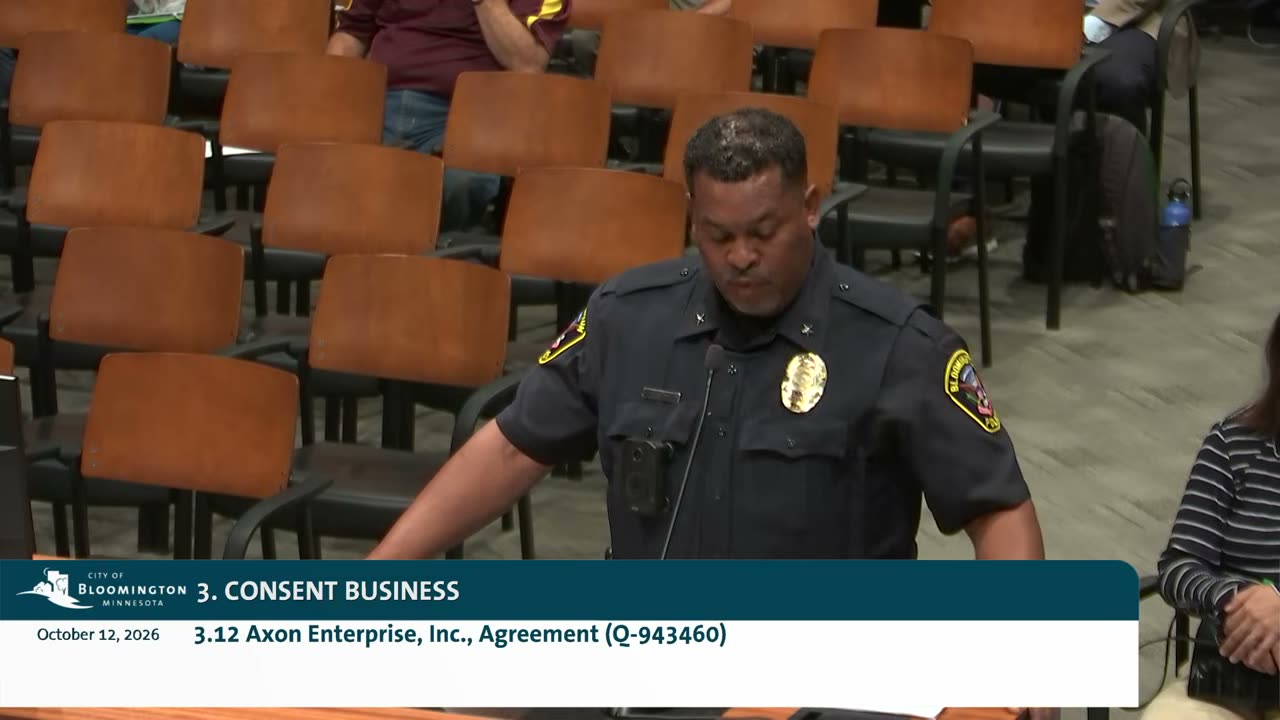
Before discussing the Axon contract, Chief Booker Hodges addressed a recent shooting near Harriet Avenue, in which he said about 100 rounds were fired and homes were struck, and a threat against a large community partner. He urged residents not to judge the Somali American community based on the actions of a few, while saying those responsible would be arrested. He also reported that the man who tried to kill five Bloomington officers on Dec. 4 received the maximum sentence.
Following this: Harriet Avenue shooting: Warrant served, chief's plea
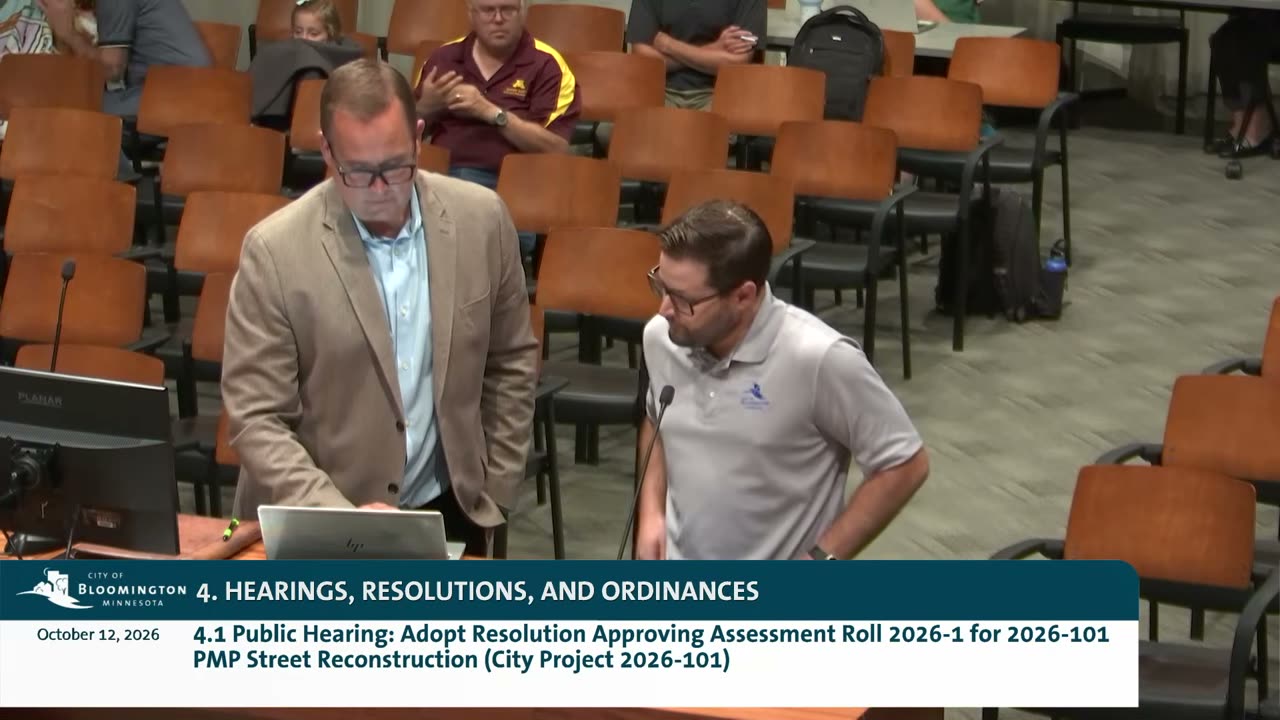
After a public hearing at which no one spoke, the council voted 7-0 to adopt assessment roll 2026-1 for the 2026 Pavement Management Program reconstruction project, covering street segments 1 through 13. Staff said the project cost just over $8.6 million and that about 170 parcels are being assessed; single-, two- and three-family homes are assessed at a 25% rate and other properties at 50%. Owners can prepay without interest until Nov. 24. Unpaid balances will be spread over 10 years at 5.5% interest, starting with May 2027 property tax statements. One resident had indicated a possible appeal.
Decided: The council approved the 2026 street reconstruction assessments; property owners can prepay with no interest until Nov. 24, and any unpaid balance moves to property taxes over 10 years at 5.5% interest starting in May 2027.
Result: Approved, 7 to 0, by voice vote
Following this: 2026 street rebuild assessments: Payoff by Nov. 24
The council voted 5-2 to rezone 9025 and 9033 James Avenue South from R1 to R3 and to approve final site and building plans and the plat, which subdivides two single-family lots into nine detached townhome lots and an outlot. Council members Dallessandro and Carter voted no. They cited concerns about piecemeal mid-block rezoning, and Dallessandro noted that nothing guarantees the homes will be built promptly. The developer agreed on the record to a 40-foot height limit, below the 50 feet the code allows, and to added trees and screening; a construction management plan is also required. The developer plans to sell the lots to other builders. Several members asked for a broader review of R3 areas in the comprehensive plan update now underway.
Decided: The council approved rezoning two lots on James Avenue so nine small detached homes can be built, with homes capped at 40 feet tall and a construction plan for the neighbors.
Result: Approved, 5 to 2, by voice vote
Following this: James Avenue Townhomes: Council Approves 9-Home Plan
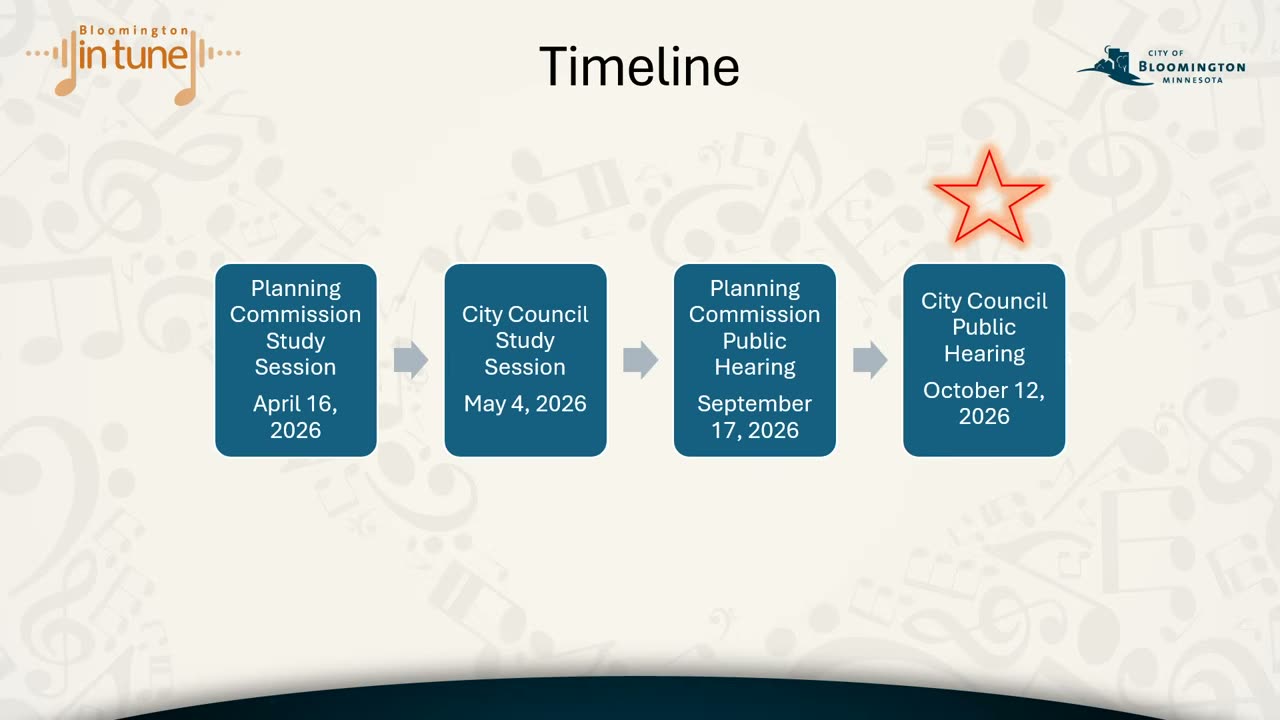
After a public hearing with no speakers, the council voted 7-0 to amend the off-street parking ordinance (city code chapters 12 and 21). The changes reduce parking minimums across land uses by roughly 10-30%, with up to 50% for industrial uses such as manufacturing and warehouses. Projects in the South Loop, Penn-American, Normandale Lake and Lyndale Avenue nodes get an automatic 10% reduction, and sites are limited to two parking-flexibility requests. The limit on vehicles parked outside a garage at single- and two-family homes rises from four to six, which staff tied to earlier changes allowing six unrelated adults to rent a home. Council Member Rivas questioned the cuts for busy retail sites, and the Planning Commission had backed the ordinance 4-1.
Decided: The council lowered how many parking spaces new developments must build, with bigger cuts in key development areas, and now allows up to six vehicles parked outside the garage at houses and duplexes instead of four.
Result: Approved, 7 to 0, by voice vote
Following this: Parking minimums cut; 6 cars allowed at home
The council heard 2027-28 budget presentations from administration, city clerk, communications, finance, legal and IT; no vote was taken. Staff reported a combined net reduction of about $197,000 for 2027 across these departments. Notable items include consolidating election precincts from 30 to 20, delaying a roughly $120,000 website redesign to 2029, and replacing the utility billing system. Staff also noted the preliminary 2027 levy increase of 6.64% set in September and $4 million in state funding secured for the North Sanitary Sewer project. Public-facing departments present next Monday, and the final budget vote is in December.
Following this: 2027-28 budget: Back-office cuts, fewer precincts
Following requests from residents at the listening session, Council Member Dallessandro asked staff to look into a humane pet store ordinance modeled on New Hope's and a wild-animal-free circus ordinance, and the mayor voiced support. Council Member Rivas, citing resident complaints, asked to revisit recent on-street parking sign changes; the mayor proposed a study session first. Other listening-session speakers raised tobacco regulation, gun violence, code enforcement, R1-to-R3 zoning and the Axon technology.
Decided: Without a formal vote, the council asked staff to look into rules banning the sale of puppies and kittens from commercial breeders in pet stores and banning circuses with wild animals, and agreed to hold a study session on recent street parking sign changes.
Following this: Pet store and circus animal rules: What's next
Oct. 19 · Meeting
City Manager Zach Walker said the council hears 2027 budget presentations from the city's public-facing (external services) departments next Monday.
Nov. 11 · Deadline
Last day to appeal an assessment on the 2026 PMP street reconstruction roll, adopted Oct. 12: state law allows 30 days to serve notice on the mayor or clerk, then 10 days to file in district court. Staff said one resident had signaled a possible appeal.
Nov. 16 · Meeting
Council budget study session with public comment on the 2027 levy and budget, which includes the first Axon payment.
Nov. 24 · Deadline
Last day to prepay a 2026 PMP street assessment with no interest; any balance goes on property taxes over 10 years at 5.5% (staff said it first shows up on May 2027 tax statements).
December 2026 · Meeting
Deputy City Manager Elizabeth Tolzmann said staff will bring a proposed 2027 state legislative platform to the council in December, after meeting legislators following the November election.
Dec. 7 · Public hearing
Truth in Taxation public hearing on the 2027 levy and general fund budget, 6:30 p.m., council chambers.
Dec. 14 · Vote
The council is set to adopt the final 2027 levy and budget, including the internal services budgets presented Oct. 12 and the first Axon payment.
Early 2027 · Meeting
Bloomington 2050, the comprehensive plan update, begins Phase 2 (Vision & Values); Mayor Busse pointed to it when Councilmembers Carter and Lowman asked to revisit where R-3 zoning is guided.
Dec. 1, 2027 · Deadline
Deadline for the council to adopt any precinct consolidation (the clerk proposes studying a cut from 30 to 20) in time for the 2028 state elections.
Oct. 12, 2028 · Deadline
The James Avenue CityHomes site and building plans expire if no building permit has been issued, unless the owner gets the one allowed extension of up to a year.
No date yet · Takes effect
The James Avenue rezoning (passed 5-2) and the off-street parking ordinance (passed 7-0), including the six-vehicle limit, take effect once their summaries are published in the official newspaper.
No date yet · Follow-up
Before using drones under the new Axon agreement, state law requires the police department to take public comment and post a written drone policy, and the council to offer public comment at a regular meeting.
No date yet · Follow-up
Staff are to look into humane pet store and animal-free circus ordinances, possibly borrowing from other cities.
No date yet · Follow-up
A council study session on recent on-street parking sign changes, at Councilmember Rivas's request, before any public hearing.
No date yet · Follow-up
Mayor Busse suggested staff consider more active ways to tell residents a year or two ahead that their street is coming up for a PMP project.
What was asked, what the room said, and what the public record answers. Times are from the captions and approximate.
Asked by Councilmember Carter (pulled the item from consent); Councilmember Dallessandro
In the room
Police Chief Booker Hodges said the contract adds drone-as-first-responder and translation and dispatch tools; that the data sits on Axon's servers while the city controls who is credentialed to see it; that every view is logged; that audits are posted on the city's website; and that officers who misuse the data would be fired. He said he chose not to use Flock over its data-sharing protocols. The council approved the agreement 7-0.
What the record says
Approved 7-0: a 10-year, $22.1 million Axon agreement that keeps the license plate readers and adds Drone First Responder and a fixed-wing drone. State law bars police drones without a warrant except in listed cases, such as emergencies, and requires drone data be deleted within seven days unless it's part of an active investigation. A 2025 audit of BPD's Axon body cameras found access limited by job, logged and with no discrepancies.
Asked by Councilmember Dallessandro
In the room
Staff said engineering tracks a five-year plan but would have to double-check whether it's on the city's online maps. Staff said residents get survey letters about two years before a project, and the mayor suggested more active notice a year or two ahead.
What the record says
Yes, roughly. The city's Pavement Management Program StoryMap has a five-year map of possible future overlays, reconstructions and trail projects, plus a map of the next three projected years. It was last updated in April 2025, so call Engineering at 952-563-4870 to confirm. For this year's roll, adopted Oct. 12, owners can pay before Nov. 24, 2026, with no interest; otherwise it's spread over 10 years at 5.5%.
Asked by Councilmember Lowman
In the room
Planner Liz O'Day said she knew of no past case of the city capping height below what code allows. Planning Manager Nick Johnson said other R-3 projects would get conditions case by case through public review, and that single-family homes usually run 32 to 35 feet. The developer agreed on the record to 40 feet.
What the record says
No, not automatically. R-3 zoning allows 50 feet; the 40-foot cap is condition 17 on this project's site and building plans, which the developer agreed to. Another R-3 rezoning on the block would get its own conditions through its own public review. The council approved the plans 5-2 on Oct. 12.
Asked by Councilmember Carter (building on Councilmember Dallessandro's concern about public benefit)
In the room
Planning Manager Nick Johnson said the city relies on private parties to build after it grants approval, that no public subsidy is involved, and that this is a limit of zoning law. Carter and Lowman asked for a broader look at where R-3 zoning is guided; Mayor Busse said the comprehensive plan update is under way.
What the record says
No. The developer plans to plat the nine lots and sell them to builders, and nothing in the approval requires homes by a date. The one built-in clock is that the site and building plans expire two years after approval if no building permit is issued, with at most one one-year extension; the rezoning itself doesn't lapse. The comprehensive plan update, where the R-3 map could be revisited, starts its next phase in early 2027.
Asked by Councilmember Dallessandro
In the room
Staff said parking a semi on the street violates the commercial vehicle rules. Staff also said two commercial vehicles up to 25 feet are allowed and count toward the six. Environmental Health staff said inspectors link cars to a house by watching for a pattern over several visits and looking up plates in state vehicle records.
What the record says
Semis aren't allowed: code caps any vehicle parked in a residential district at 22 feet long and 12 feet tall, and bars commercial vehicles from residential streets. Code allows one commercial vehicle per home, which counts toward the limit, plus up to two trailers up to 25 feet long, which don't. That differs from the "two commercial vehicles" staff described in the room, and the new ordinance keeps the one-vehicle rule. The six-vehicle limit covers cars "outside a garage or on a street" with no set distance from the house.
Asked by Councilmember Lowman
In the room
Environmental Health staff said street parking is open to everyone, but a car left for days, inoperable or on jacks can be reported to police, who check it as a low priority. Environmental Health writes orders for prohibited vehicles tied to a house and works with police. Lowman said he worried the 24-hour rule could be a "trick bag" for busy households.
What the record says
The city bars parking on a street for more than 24 consecutive hours and on any right-of-way within 48 hours after a snow emergency is declared. The parking ordinance passed Oct. 12 didn't change those rules. Enforcement requests go to the police non-emergency line, 952-563-4900.
Asked by Councilmember Rivas
In the room
Planner Liz O'Day said the 50% cuts are mostly for industrial uses like manufacturing and warehousing, general retail is cut about 26%, and online shopping has left many lots empty. Mayor Busse said the council had asked for targeted adjustments. The ordinance passed 7-0.
What the record says
The 50% cuts are for manufacturing, warehousing and wholesale. Retail drops 27% to 28% for stores under 100,000 square feet and about 26% to 43% for larger ones; office drops 12% and restaurant seating 25%. The new minimums apply to future development, not existing lots, and the ordinance passed 7-0.
Asked by Councilmember Dallessandro
In the room
The city clerk said costs follow a four-year cycle with a presidential primary and possible special elections, so they're hard to predict. She said the city is consolidating precincts from 30 to 20 and returning polling places to schools, and that a state law lets the city shorten in-person absentee voting from 46 days to 18 for smaller elections, but not for a big general election like 2028.
What the record says
The clerk's 2027 budget lists evaluating a cut from 30 to 20 precincts and shorter absentee periods "where permitted by law." For the 2028 state elections, any precinct change must be adopted by Dec. 1, 2027. State law sets a 46-day in-person absentee window and 18 days of early voting; we couldn't confirm in the statute a change letting cities shorten the 46 days.
Asked by Councilmember Dallessandro (after a listening-session speaker)
In the room
Dallessandro asked staff to look into both, citing New Hope and other cities. Mayor Busse agreed if it could mostly be copied from other cities' ordinances, and said staff would decide which department takes it.
What the record says
Still open. As of Oct. 13, 2026, staff have been asked to look into both, with no draft or date. A 2026 state bill, HF 2627, would ban pet shop dog and cat sales statewide and let cities go further; we couldn't confirm it became law. Eden Prairie has regulated pet store sales since 2018, per an ordinance copy we couldn't check against its current code.
Asked by Councilmember Rivas
In the room
Rivas said residents keep contacting him about sign changes and asked for a review and a public hearing, saying city code calls for one when signs change permanently. He has sent a document to City Manager Zach Walker. Mayor Busse proposed starting with a study session that looks back at the changes, and Rivas agreed.
What the record says
Still open. As of Oct. 13, 2026, a study session is planned with no date, and the specific sign changes weren't named in public. Under the council's 2013 on-street parking policy, changes start with a petition or a city study, then a mailed neighborhood ballot, with a 15-day appeal to the council. The council adopts the official parking map at a hearing as needed.