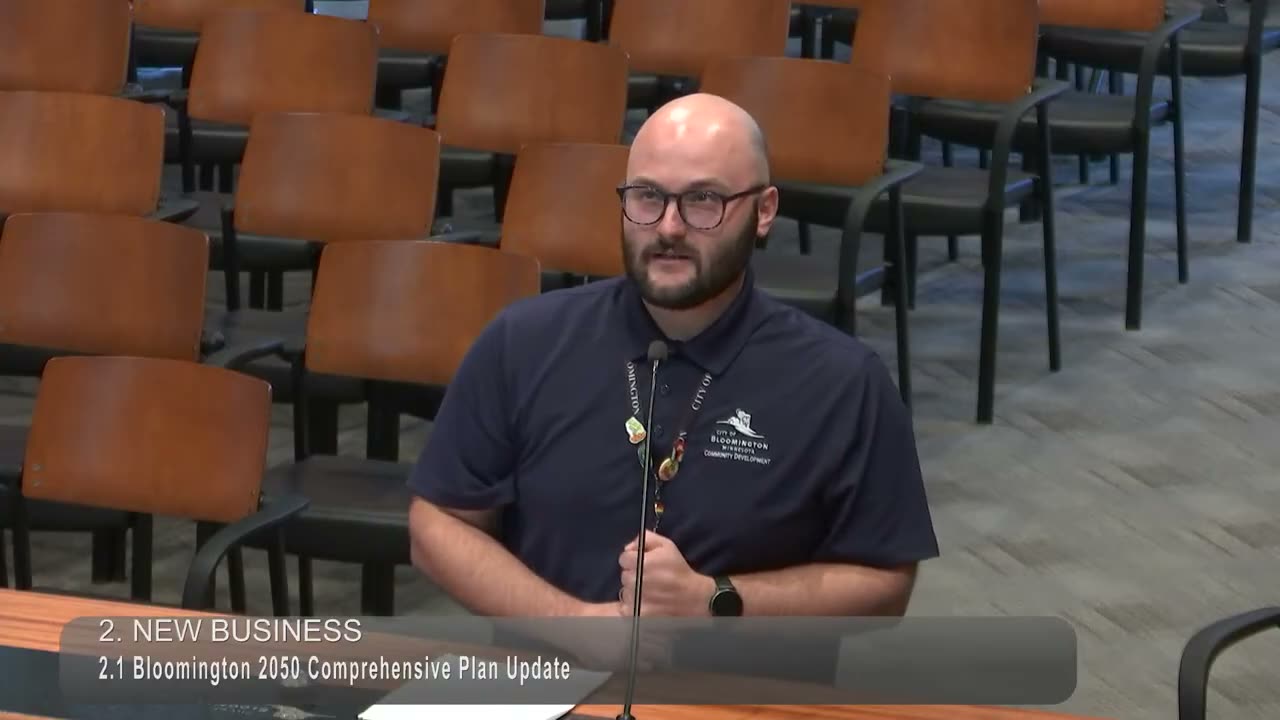
City planning staff presented the draft vision statement, six strategic priorities and guiding principles (equity, sustainability, livability) for Bloomington 2050. The drafts are based on summer outreach that logged 646 interactions across 15 events, 489 six-word-story postcards and 172 survey responses. Several commissioners questioned the 'lead on climate action' priority, saying the city has little control over climate outcomes, and objected to wording that says the city 'ensures' housing. Others said the statements read generically, could apply to any suburb, and should do more to set Bloomington apart. One commissioner asked that the plan resolve sites guided for medium density but zoned R-1, a conflict that has complicated recent projects. Phase two public engagement starts in early 2027, with council approval of the priorities targeted for April, and the plan is due to be finalized in 2028. This will also be the first Bloomington comprehensive plan with a dedicated economic development chapter.
Following this: Bloomington 2050: Where the plan stands
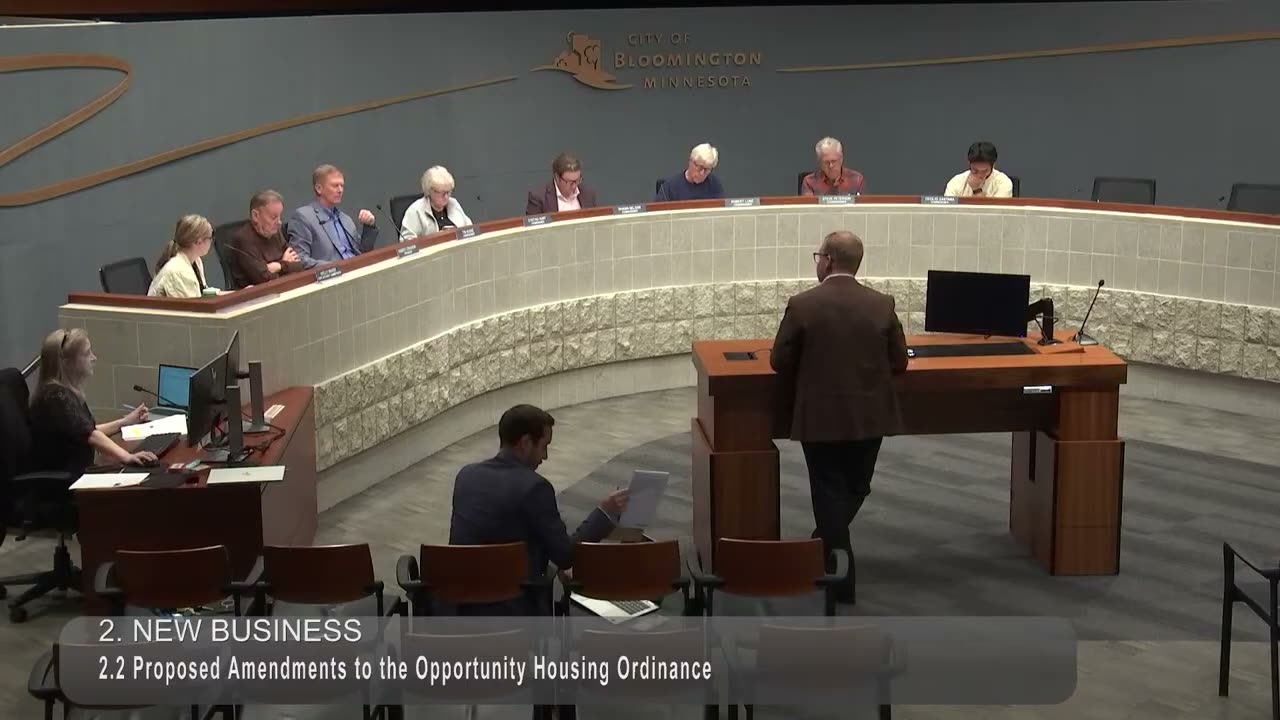
Staff proposed amendments to the Opportunity Housing Ordinance, the city's 2019 inclusionary zoning policy. Staff said the ordinance has produced 693 units affordable at 60% of area median income or below. Requirements would be based on rental versus ownership rather than building type. Rental developers could choose from three options: 9% of units at 60% AMI, 4% at 50% AMI, or 3% at 30% AMI. Ownership projects could choose 9% at 115% AMI or 4% at 80% AMI. The fee-in-lieu would rise from $9.60 to $12 per square foot to account for inflation, and parking-reduction incentives would shrink by 10 percentage points to match lower parking mandates. Staff asked the board to direct them to send the amendments to the City Council; the transcript ends before any vote is recorded. Next steps are the HRA on Nov. 10, a Planning Commission public hearing on Nov. 12 and a City Council public hearing on Dec. 14, with a new compliance cycle starting Feb. 1, 2027.
Following this: Opportunity Housing Ordinance: Changes up for review
Under the ordinance, existing buildings of 20 or more units become subject to affordability requirements if improvements exceed 20% of the building's value. Several commissioners said this trigger could discourage owners from investing in maintenance. They asked how renovation is defined, how the 20% is calculated, and whether casualty repairs, such as rebuilding after a fire, would count. Staff acknowledged the ordinance has no precise definition of rehabilitation and no casualty provision. Commissioners urged staff to tighten the definitions and create a formal appeal process. One commissioner recalled that the provision grew out of tenant displacement after a large apartment complex near Normandale and American Boulevard was bought and fully renovated with higher rents.
Following this: Opportunity Housing Ordinance: Changes up for review
A commissioner asked whether the ordinance's added costs might be driving away market-rate development. If so, the commissioner argued, it could weaken the 'filtering' effect by which new housing eases prices further down the market, and could raise costs for middle-income renters. The commissioner said the information before the board did not show whether that is happening. Staff responded that a supply-impact analysis was outside the scope of this update, which works within the framework the council adopted in 2019. Staff also noted the Roslyn, the newest building under the ordinance, includes units at 30% and 50% AMI.
Following this: Opportunity Housing Ordinance: Changes up for review