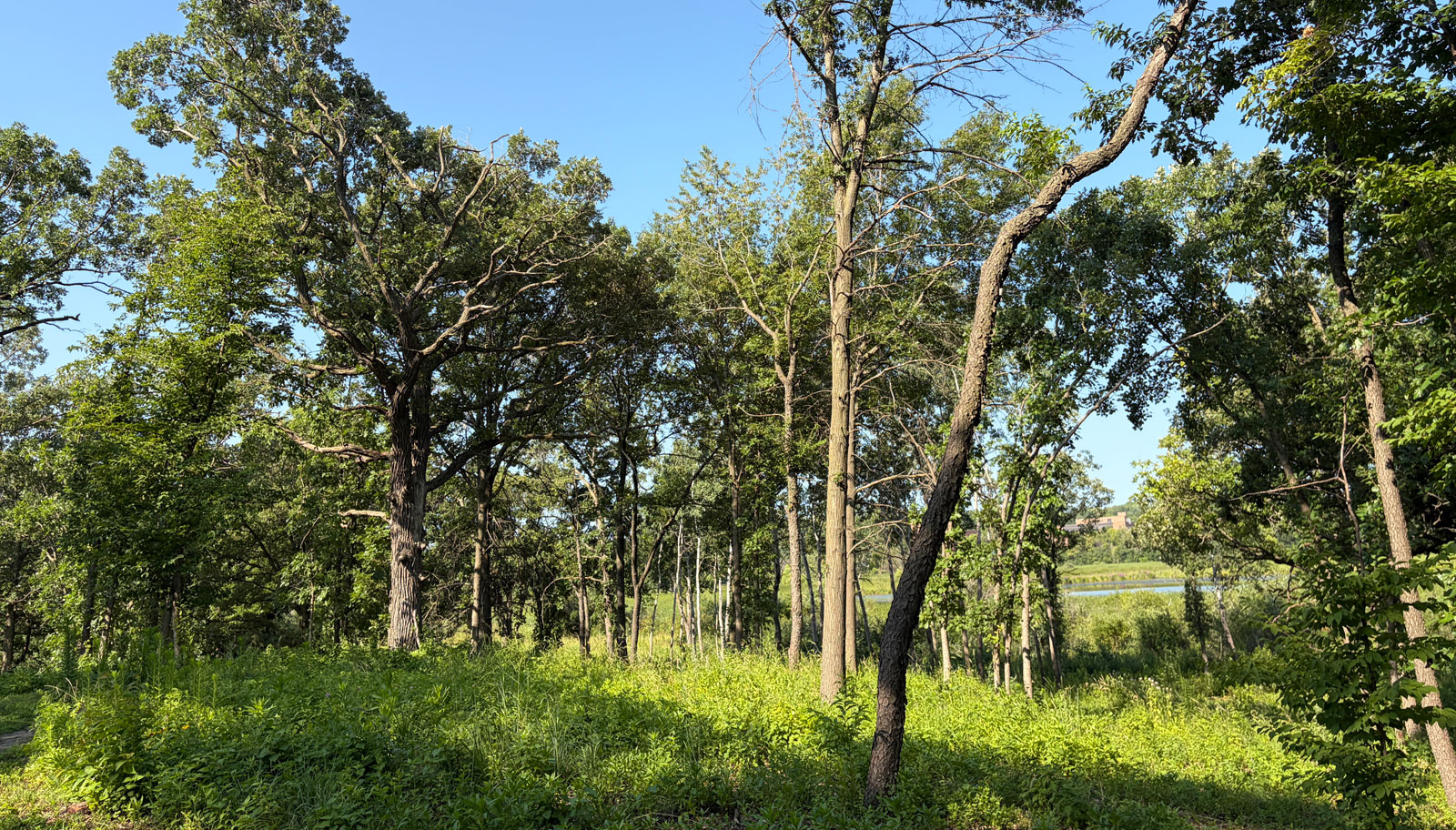

If you haven't been to Parker's Picnic Area in a while, it's worth a walk. The hillsides at 10401 Columbus Road used to be a wall of buckthorn. Now native grasses grow there, and Public Works points to the spot as its best example of what oak savanna restoration can do.
In a briefing posted Sept. 30, Natural Resources Specialist Wade Yunker said the restored hillside shows what's possible. The city's tools are prescribed burns and steady buckthorn control. The burns aren't as drastic as they sound. Oak savannas need fire, and controlled burns bring back the natural processes that once kept these landscapes open. Yunker said the goal is the whole system, not any single plant. "Nature isn't just one thing," he said. "There's a vast variety of species. It's all connected."
Residents Heidi and Dan Niziolek have done restoration work of their own and founded Bloomington Neighbors Nurturing Nature. Heidi Niziolek's advice for anyone attached to a dense, leafy creek bank is to give it time. "It's going to feel a little different for a while," she said.
The group's efforts at Winchester Pond, the 2-acre pond near the Niziolek home, included a floating island planted with native plants to improve the water. The group has also worked at Marsh Lake Park and at Forest Glen Park. It now has projects at a handful of other parks and schools around town.
On Nine Mile Creek, the group works alongside the city near 106th Street and Humboldt Avenue South. Volunteers pull buckthorn, garlic mustard and dame's rocket and pile it up for city crews to mow. Organizers say all ages and abilities are welcome and they go "rain, snow, or shine." Bring gloves, water, sturdy shoes and clothes for the weather. The group supplies the tools. The group's Nine Mile Creek page doesn't list dates, so email [email protected] for the schedule.
The savanna work is part of a larger push along the creek, and the tree cutting it requires has drawn complaints from some residents. In an Aug. 5 briefing, the city said many of the trees coming out are invasive or fast-growing species whose dense canopy shades out native grasses, wildflowers and young oaks. It said large parts of the corridor will see little or no tree removal and that 150 to 200 new trees will be planted around Moir and Harrison parks. "This is what restoration looks like," Assistant Parks and Recreation Director Dave Hanson said. "It looks worse before it looks better, but it will look better and it will be healthier."
Construction is underway on the $20 million corridor project. It covers stream restoration, 131 acres of woodland and wetland restoration, a new playground and trail upgrades. Moir/Central Park and all of its trail access points closed Sept. 7 and will stay closed until construction wraps up. The Moir Park shelter and other amenities are being removed this September and October. A new shelter is planned for 2027, and the city expects major construction to finish in fall 2027.
Questions about the oak savanna work can go to Public Works at 952-563-8700 or [email protected].