The City Council has finished this year's miscellaneous zoning ordinance update. Members voted 5-0 to adopt ordinances R through V, a set of minor policy changes to City Code Chapters 10 and 21. The main item requires odor mitigation at cannabis cultivation, manufacturing and combination businesses within 150 feet of residential property. The package also creates a separate auto detailing use and changes the rules for trailer parking and tree preservation.
 City of Bloomington@CityofBloomingtonMN
The council voted 5-0 to adopt ordinances R–V, amending City Code Chapters 10 and 21.09/28
The odor rule is aimed at growing and processing, not ordinary retail stores, which are excluded.
Bloomington City Councilyoutube.com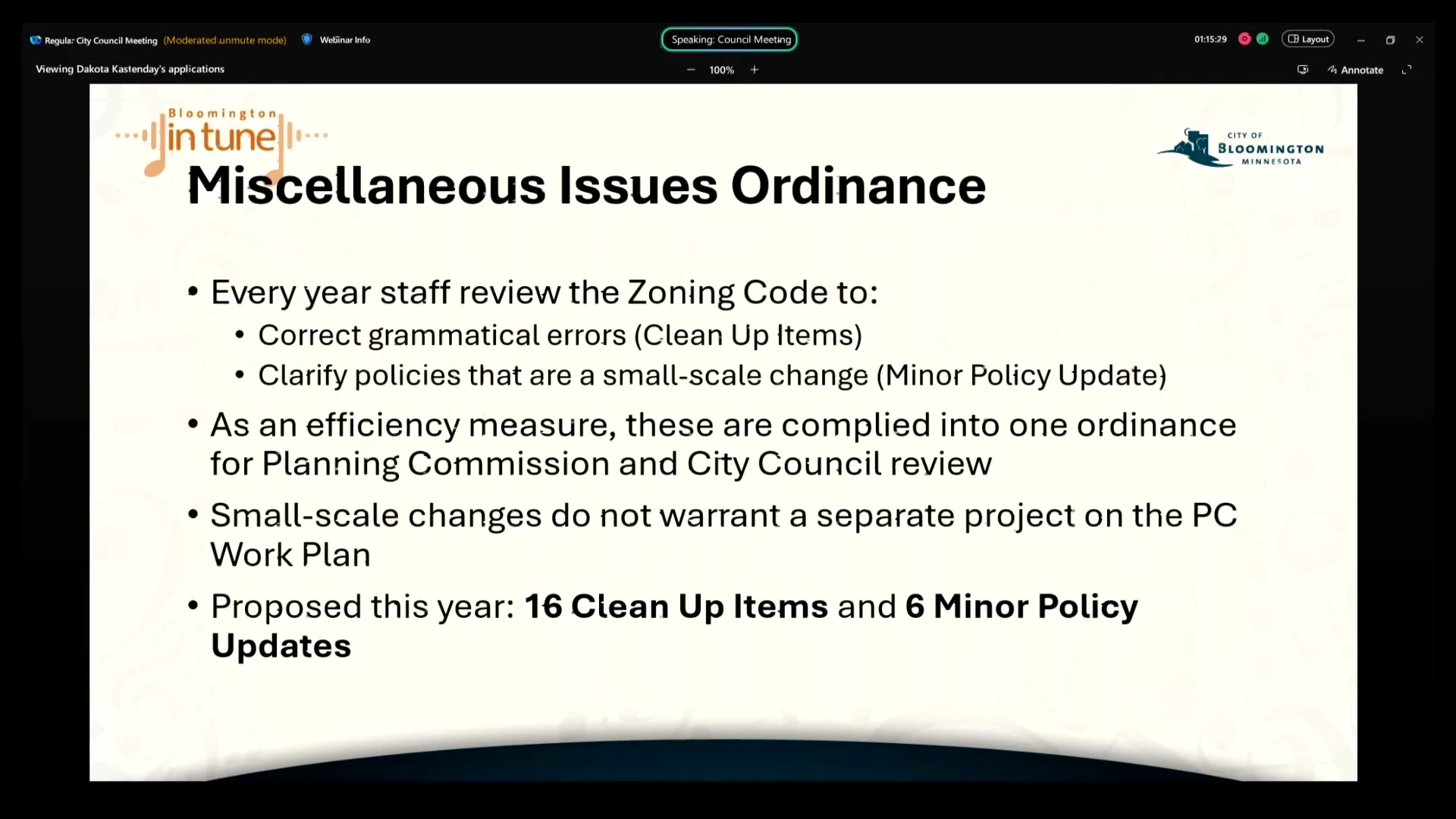
The council also voted 5-0 on the technical half of the package, ordinances A through J and L through Q, which amend City Code Chapters 1, 14, 15 and 21. Most of it is housekeeping. It fixes outdated corner-lot references and adds new medium-density housing types to the occupancy standards. The change most likely to get noticed: sheep can now do prescribed grazing alongside goats.
City of Bloomington@CityofBloomingtonMNThe council voted 5-0 to adopt technical zoning ordinances A–J and L–Q, amending City Code Chapters 1, 14, 15 and 21.09/28
Most years the city bundles small land-use fixes like these into one ordinance so each doesn't need its own process. This year's policy changes started at a council study session, where staff brought 6 proposed updates. The council backed the 150-foot odor standard for cannabis growers and processors.
City of Bloomington@CityofBloomingtonMNIn a study session on the annual miscellaneous issues ordinance, council supported requiring odor-mitigation standards for cannabis cultivation/manufacturing businesses within 150 feet of residential property (excluding standard retail), allowing car detailing as a permitted use in B2, I1, I2, and I3 zoning districts, and codifying rezoning application requirements.06/29
Once the council gave its direction, staff wrote the formal ordinance language. On Aug. 12 the city posted public hearing notices for the minor policy items, and the Planning Commission held public hearings on Sept. 3.
The Planning Division filed the Chapter 10 and 21 amendments as case PL202600141. The council held its own public hearing on them on Sept. 28, ahead of the final unanimous votes.
With the votes done, the changes are now part of the city code. Residents next to cannabis grow or processing sites are the most likely to notice the difference, and so is anyone hoping to open a detailing shop.
From the meetings: City Council Meeting, September 28, 2026 and City Council Meeting, June 29, 2026.